An open lakehouse, not another warehouse.
AZ-Five stores everything as Delta Lake tables — open Parquet with ACID commits — and queries them in place with DataFusion. We operate the storage; the format is the exit door, and it stays open.
The whole path, on open parts.
Files, databases, SaaS tools and event SDKs land as Delta tables. DataFusion reads them where they sit. Every line of the network — quality, pipelines, governance, dashboards, product analytics, models — runs on the same tables, which is the only reason they can trust each other.
-
Sources
Files, databases, SaaS connectors, event SDKs — drawn in grey, because they sit outside the system
-
Delta Lake
Open Parquet + ACID commits, managed and operated by AZ-Five
-
DataFusion
Rust query engine, Arrow-native, reading the tables in place
-
Six lines out
Quality, pipelines, governance, dashboards, product analytics, models — one trunk
Delta Lake: warehouse guarantees, open files.
The classic trade was warehouses for reliability, data lakes for openness. Delta Lake collapses it: transactional guarantees and version history, expressed as plain files in an open, documented format. AZ-Five builds on that format instead of hiding one of its own behind an API.
- ACID commits A load either lands completely or not at all. Concurrent reads never see partial state.
- Time travel Table versions are retained. Query yesterday’s state, or compare against it.
- Schema history Every schema change is recorded — and gated behind explicit confirmation at load time.
- Open Parquet Standard Parquet files plus a Delta transaction log — documented, versioned, and readable by any Delta-aware engine.
Queried in place by DataFusion.
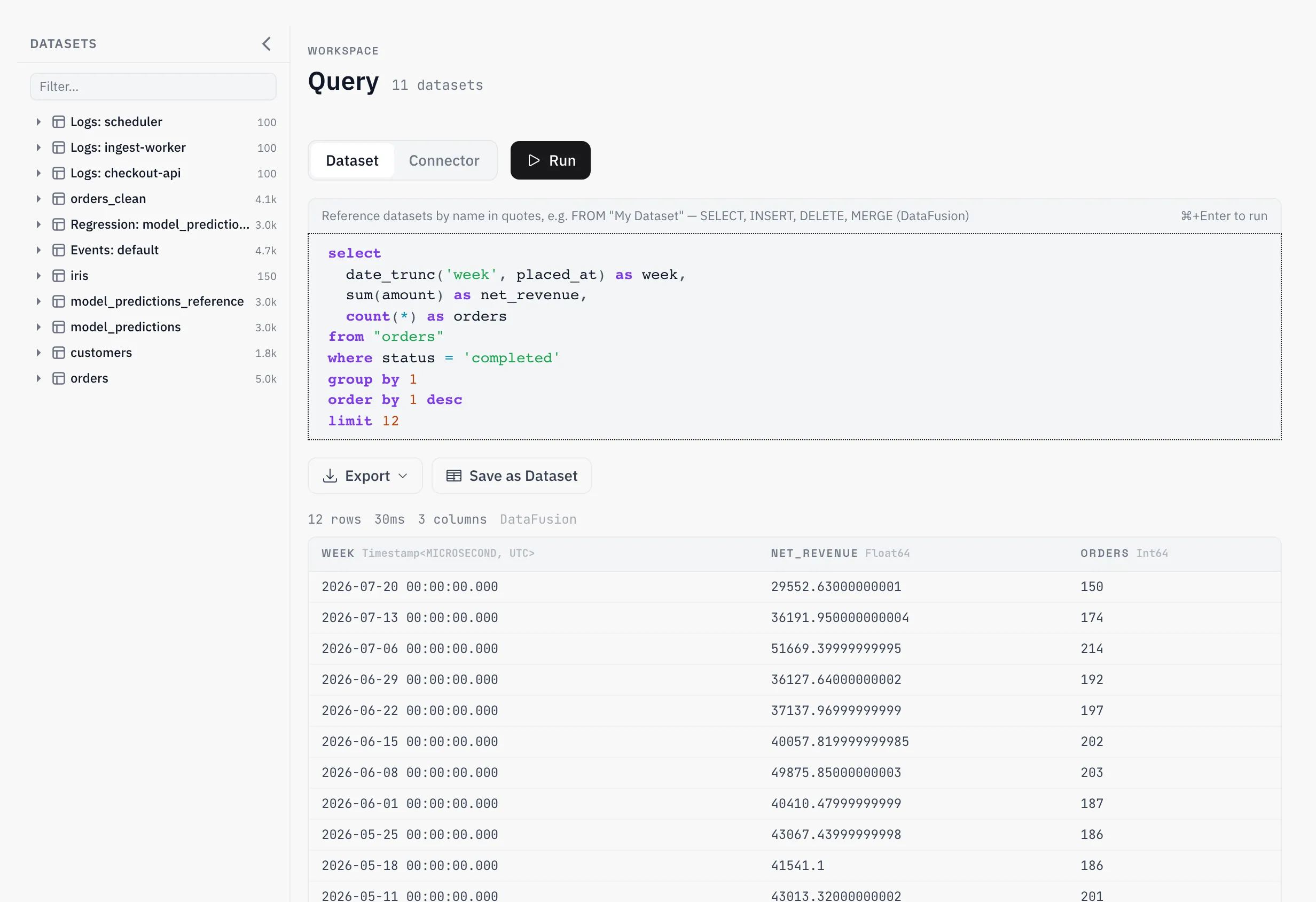
DataFusion is a Rust query engine built on Apache Arrow. AZ-Five runs SQL directly over the Delta tables — columnar, vectorized, no movement into a proprietary store first. The engine ships inside the platform; there is no cluster to size and no warehouse compute bill to explain.
Leaving must stay cheap. That's the point.
If you walked away from AZ-Five tomorrow, your data would come out as Parquet files with a Delta log and full version history — not a proprietary export format, and not a rewrite of a bespoke SQL dialect. A vendor whose storage format is open has to keep earning the renewal, which is exactly the position we want to be in.
orders/_delta_log/ · OPEN PARQUET + TRANSACTION LOG · EXPORTABLE
The lakehouse, in practice.
Where does my data physically live?
On S3-compatible object storage that we operate. What matters for lock-in is the format rather than the landlord: tables are plain Parquet with a Delta transaction log, so the data is exportable in a form other engines can read.
Is there a proprietary storage format?
No. Tables are standard Parquet files with a Delta Lake transaction log — an open, documented format. If you stop using AZ-Five, the data comes out in a form other engines can read.
Do I need to run a query cluster?
No. DataFusion ships inside the platform and queries the Delta tables in place. There is no separate warehouse or Spark cluster to size, patch or pay for.
Analytics on a format you can walk away from.
Load a table and query it in place — profiled and validated from the first row.