Models rot silently. The data drifts first.
Most production model failures aren't bugs — they're distribution shifts that start upstream, in the data. AZ-Five watches your models with the same machinery that watches everything else, so drift gets caught at its source.
Bring your own model. Keep your training stack.
Train wherever you like and upload the model as ONNX — validated on arrival and executed through onnxruntime, never unpickled, so an uploaded file can't run arbitrary code. Pick a reference dataset and its distributions seed the drift checks from day one. Re-upload to version; the history stays.
- Export One-line export from scikit-learn, XGBoost or LightGBM via skl2onnx.
- Upload ONNX validated at the door; a wizard introspects the model and you map feature columns to its input tensor.
- Score Re-score whole datasets, run the model as a pipeline task, or predict inline what-if rows.
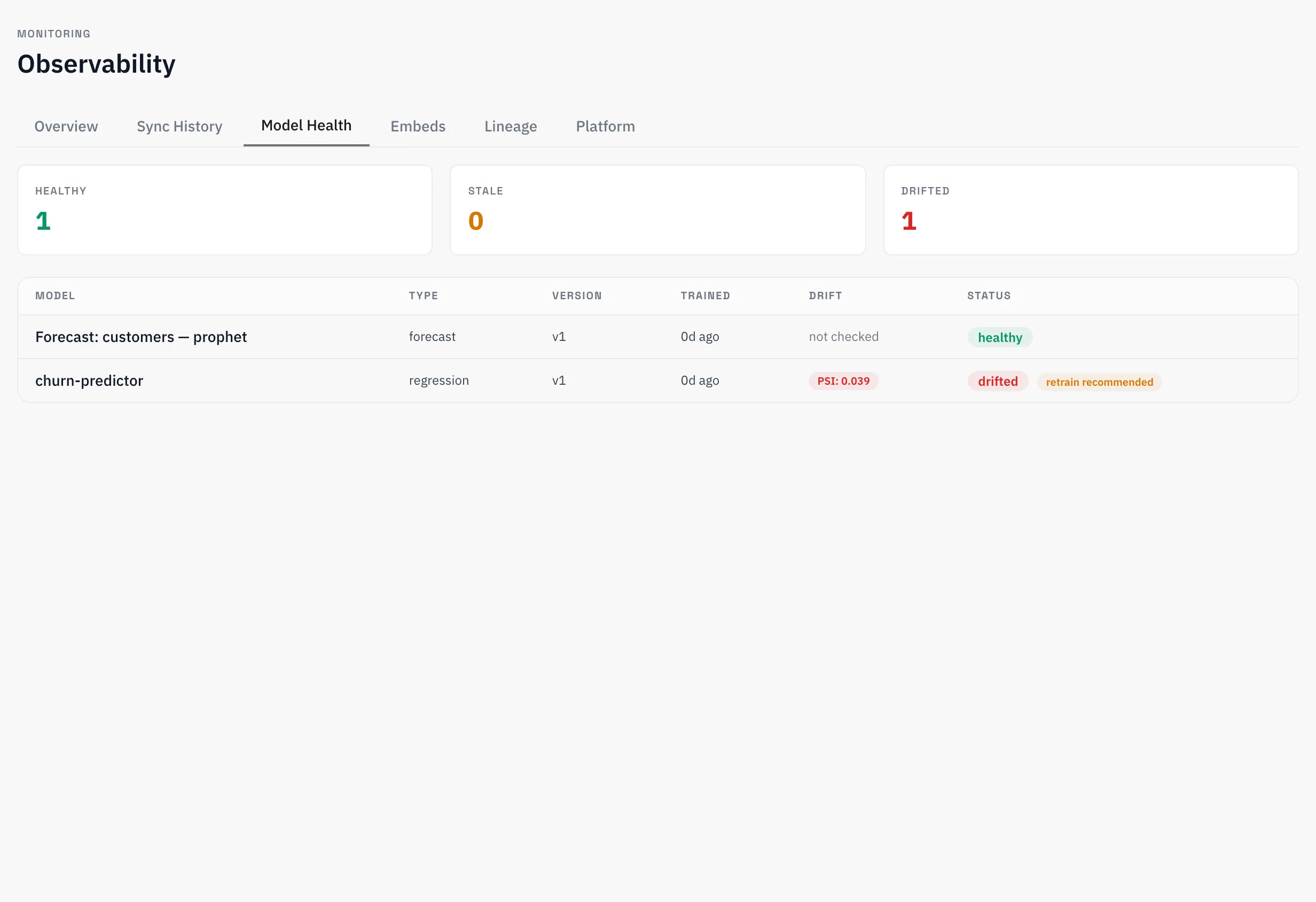
- Monitor Drift, realized performance and inference volume tracked over time against a reference dataset.
Drift, tested per column — not vibes.
Every feature is tested against the reference window with a statistical test chosen by column type and sample size, rolled up to a drifted-column share and a severity. A drifted model is flagged where everyone already looks — and when ground truth arrives, realized accuracy trends right next to the drift signal.
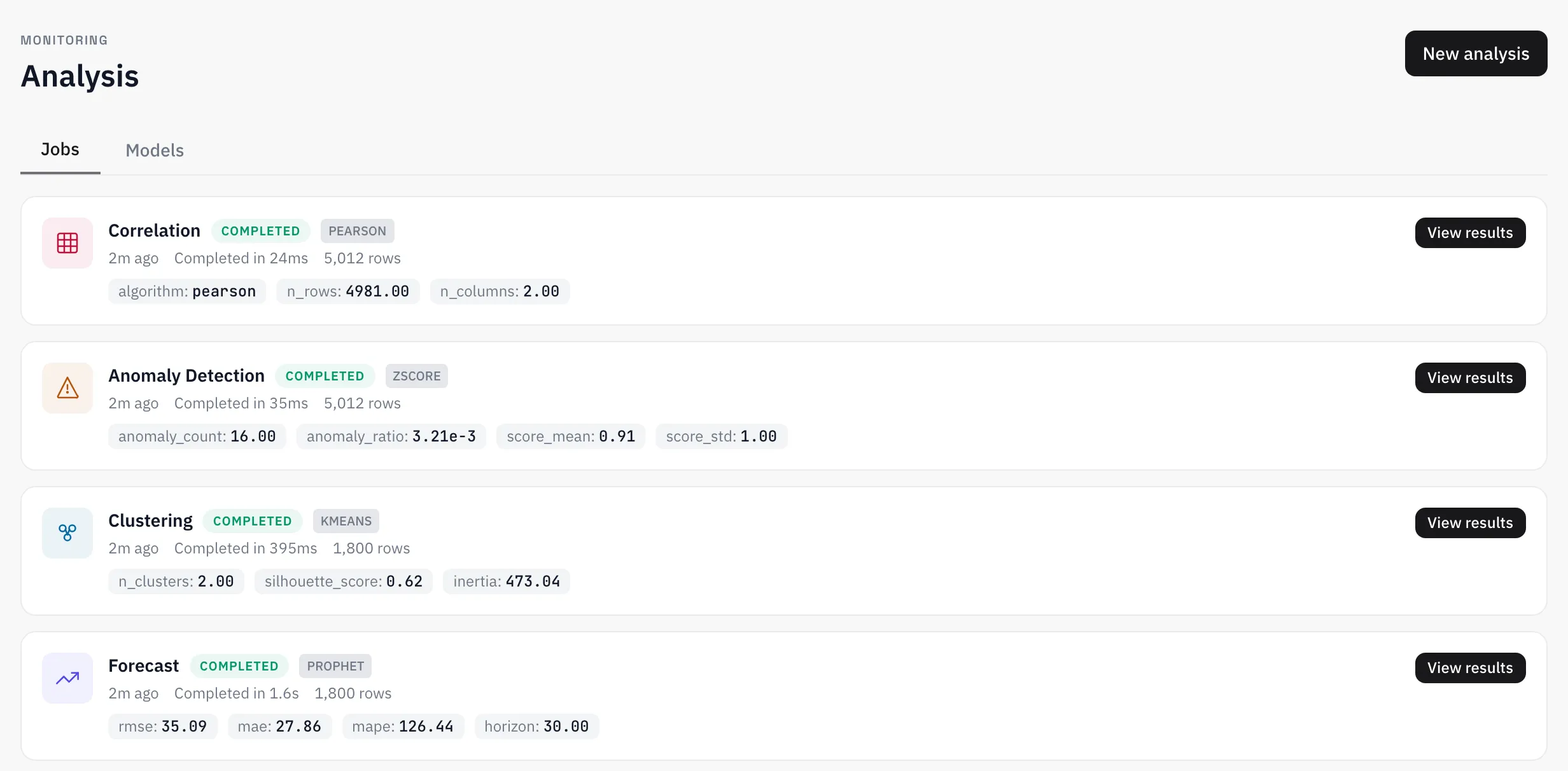
Analysis jobs, no notebook required.
Forecasts, clustering, anomaly detection and correlation run as jobs on any dataset — auto-configured from the data's own shape, with the trained model saved and versioned like any other. The line between “analytics” and “ML” is a dropdown, not a hiring plan.
Model health and data health. One graph.
Most stacks split this problem: an MLOps tool watches the model, a data-quality tool watches the tables, and nobody owns the hand-off where failures actually start. Here both live in the same lineage graph, governed by the same rules — a data incident and a model incident are the same investigation.
Know before the quarterly review does.
Upload an ONNX model, point it at a reference dataset, and drift checks start with the first score.