The orchestrator is in the box.
Most teams bolt a scheduler onto their analytics stack and maintain the glue forever. AZ-Five builds the DAG in — and because it lives with the data, the platform itself can pull the trigger.
Wire it on a canvas, not in YAML.
Drag tasks from the palette, connect their outputs, and each task configures itself from its own schema. The graph you draw is the graph that runs — success edges, failure edges, gates and all.
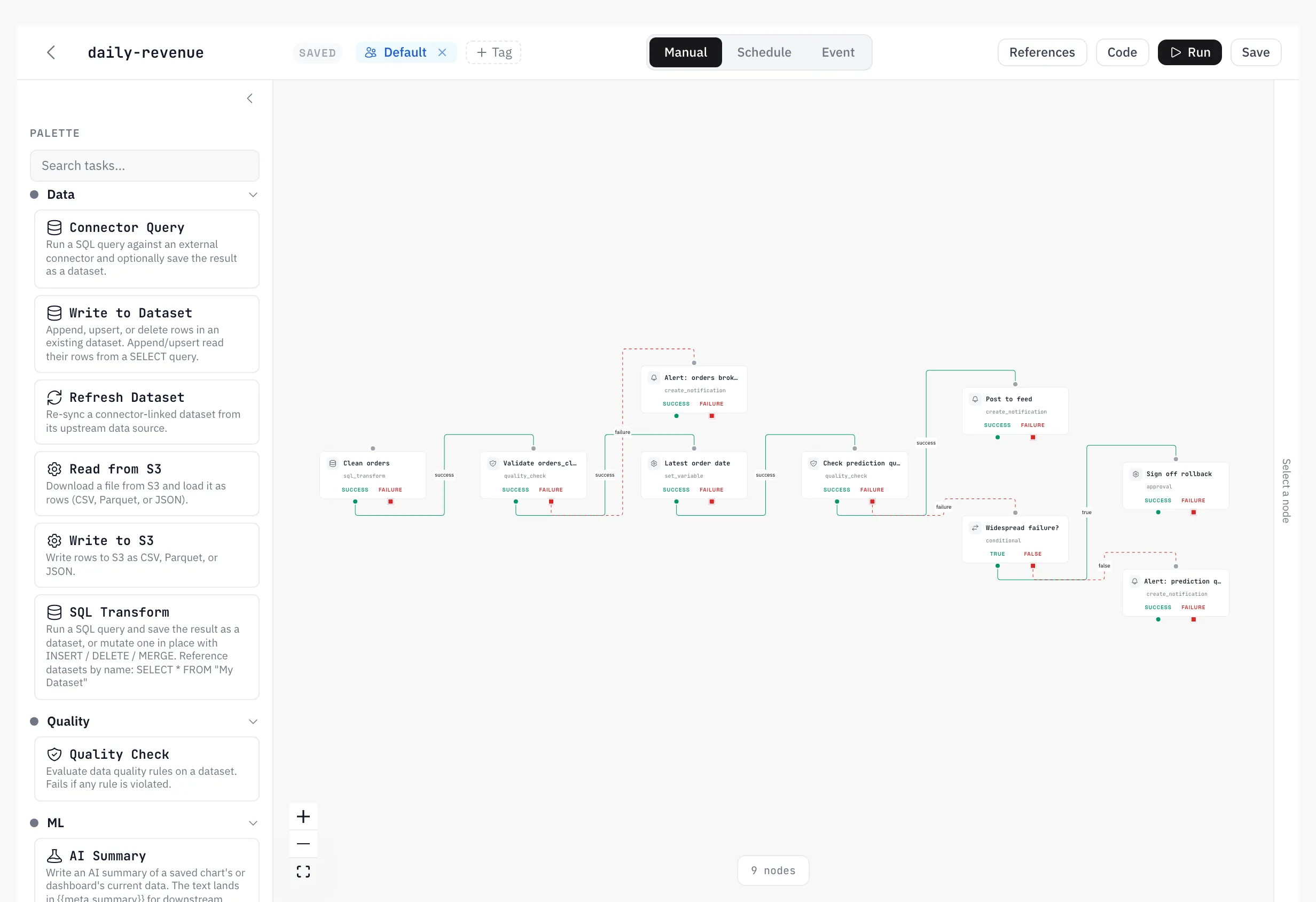
28 task types, seven categories.
The palette covers the work a lean data team actually automates: moving and transforming data, checking its quality, scoring models, telling people, and controlling the flow. No plugin marketplace to audit — the tasks ship with the platform and run next to the data.
28 TASK TYPES · CONFIGURED FROM THEIR OWN SCHEMAS
- Data — 6 types SQL transform, dataset write, dataset refresh, connector query, S3 read, S3 write.
- Quality — 1 type Evaluate a dataset’s rules mid-run; the task fails if any rule is violated.
- ML — 5 types Run an analysis, rescore or retrain a model, check drift, write an AI summary — narrative from the model, numbers from the engine.
- Notification — 4 types Slack message, chart-to-Slack, email, or an in-app notification.
- Logic — 7 types Conditionals, loops, sub-pipelines, scripts, waits, variables, approval gates.
- Integration — 4 types HTTP request, HubSpot upsert, Google Ads conversions and customer match.
- Output — 1 type Publish a run’s result as a dataset — the terminus other surfaces read.
The platform pulls its own triggers.
An external orchestrator can only poll. Because pipelines live with the data, AZ-Five fires them from the inside: a quality rule fails and the repair pipeline starts before anyone reads a broken dashboard.
- On a schedule Cron-style schedules with a timezone, managed next to the pipeline.
- On an event A failing quality rule, a finished connector sync, another pipeline completing.
- By hand Run now, with per-run variable overrides when you need them.
Failure is a path, not a page.
Every task has success and failure outputs. Wire the failure path to an alert, a rollback or a conditional; set retries and timeouts per task. A handled failure keeps the run green — the red stays on the task that earned it, with its logs attached.
A person in the loop, by design.
An approval gate pauses the run until someone signs off, with a message that carries the numbers behind the decision. Put one in front of anything irreversible, and nothing destructive happens unattended.
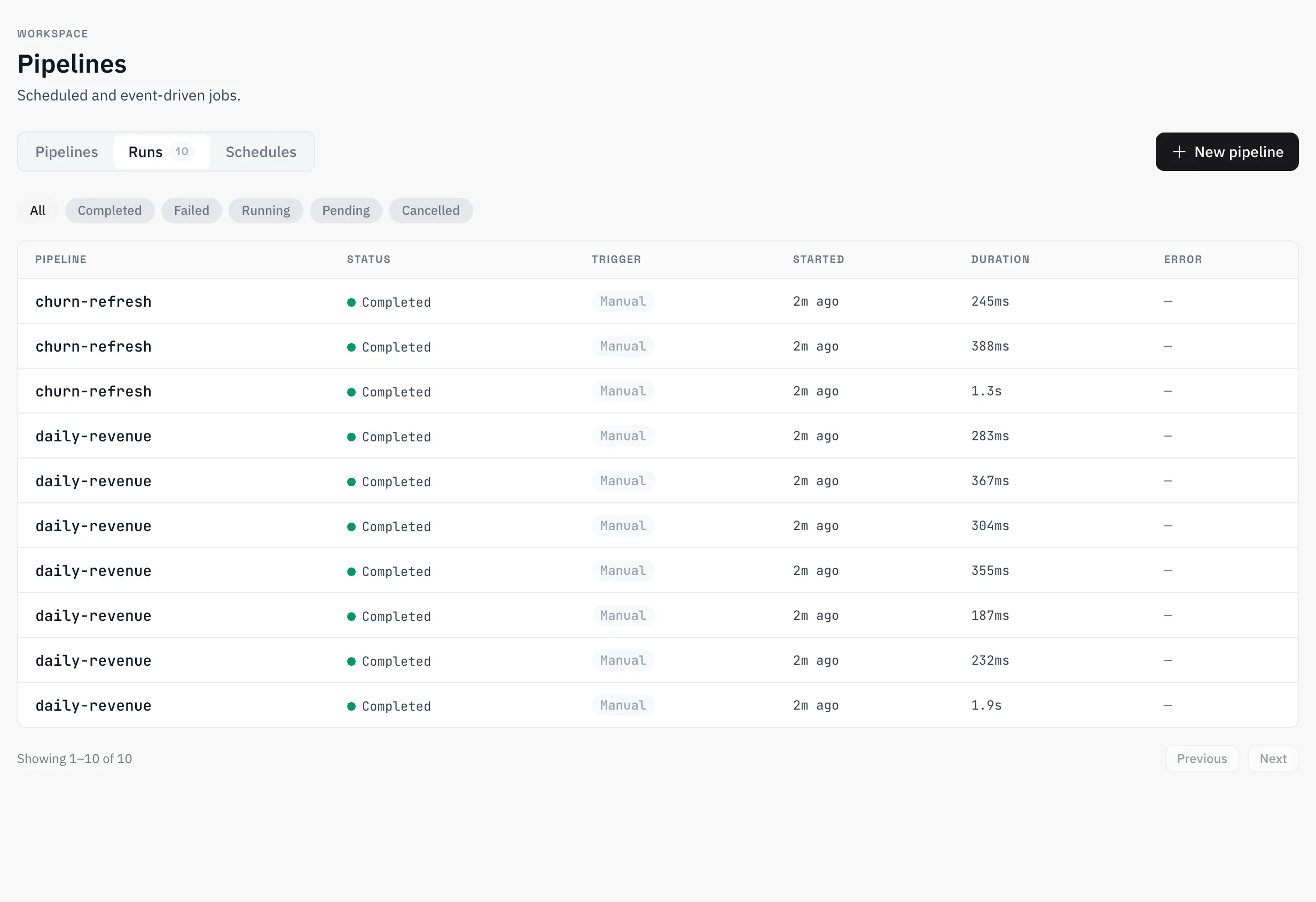
Every run, on the record.
Each run snapshots the graph it executed and records per-task status, timing and logs. When something needs explaining, the explanation is a link — not an archaeology project.
Where this line interchanges.
Retire the glue repo.
Your first pipeline is a transform, a quality check and a notification — wired in about five minutes.